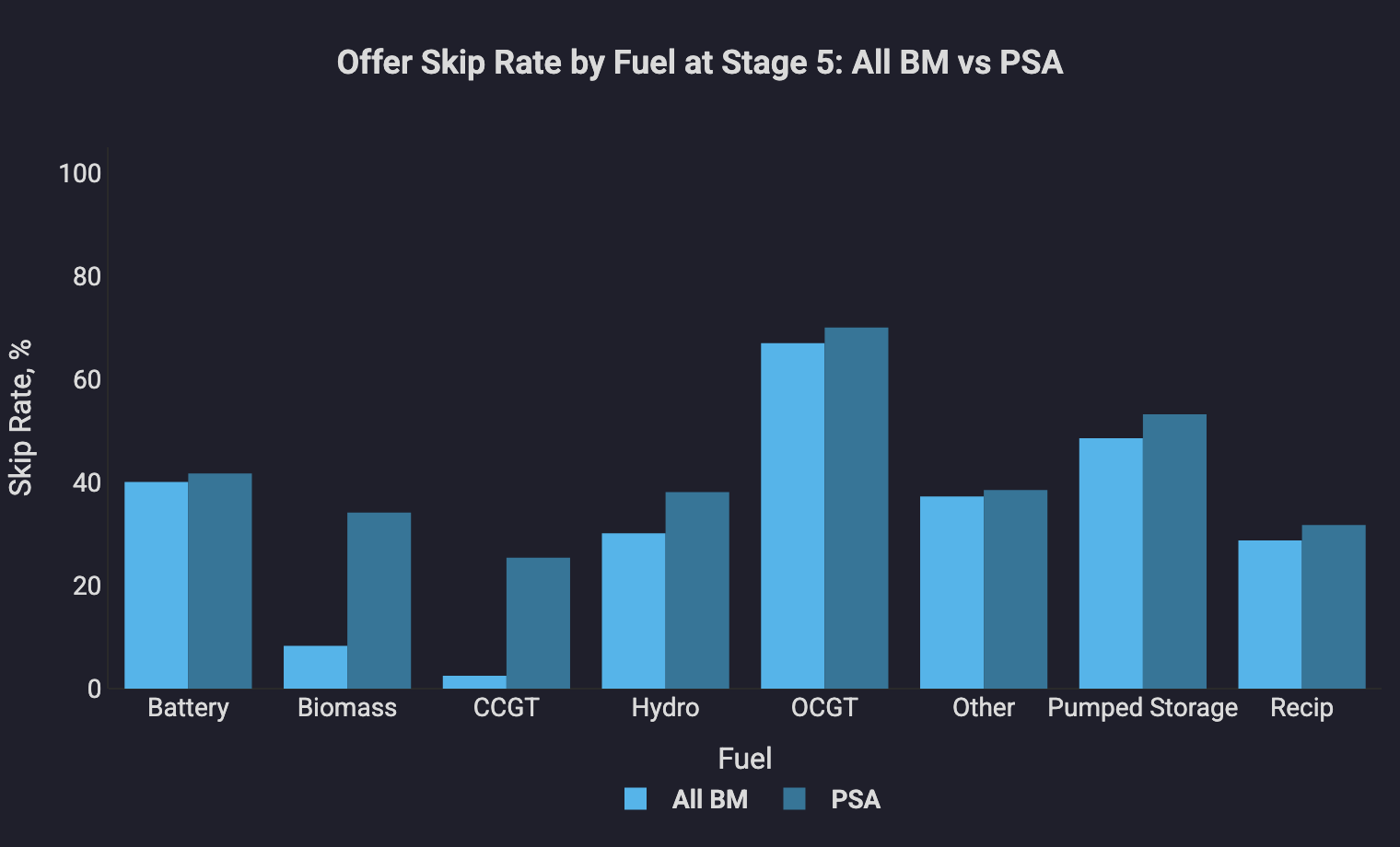
Skip Rate Exclusion and Displacement
The NESO mechanism for evaluating skip rates features 5 exclusion stages (6 if you include the monthly process to account for units providing Mandatory Frequency Response).
| Stage | What it removes |
|---|---|
| 1 | Wind offers |
| 2 | Very-long-notice units, units behind active constraints |
| 3 | System-tagged units |
| 4 | Unwinds - orders which would undo existing acceptances |
| 5 | Long-notice units, infeasible pumped storage, and units ramping between 0 and SEL |
| 6 | Mandatory Frequency Response (MFR) |
It's tempting to think that your skip rates will be most affected by the stages in which you are excluded, which for batteries are Stages 2 (behind constraints) and 4 (unwinds), but the process contains subtle complexity. At each stage, accepted bids or offers can be added to or removed from the Acceptance Stack, which changes the Imbalance Requirement used by NESO to determine how much volume should go into the In Merit set. We call this Indirect Exclusion. Also, in the All BM methodology, system tagged trades can be forced into the In Merit stack, which we call Displacement.
To keep this clearer, these are our definitions for the exclusion categories. Note that these are not NESO terms:
| Direct Exclusion | Orders being removed from skip rate calculations at a given stage, because they meet the exclusion criteria of that stage. |
| Indirect Exclusion | Orders being removed from skip rate calculations at a given stage, because the exclusion of other accepted orders reduces the Imbalance Requirement. |
| Displacement | Orders being removed from skip rate calculations because system tagged orders are forcibly added to the In Merit stack. |
This note explores that process, because understanding this is crucial to interpreting your skip rates.
Typical battery skip rate pattern
Take an example battery unit's skip rates over a chosen month.
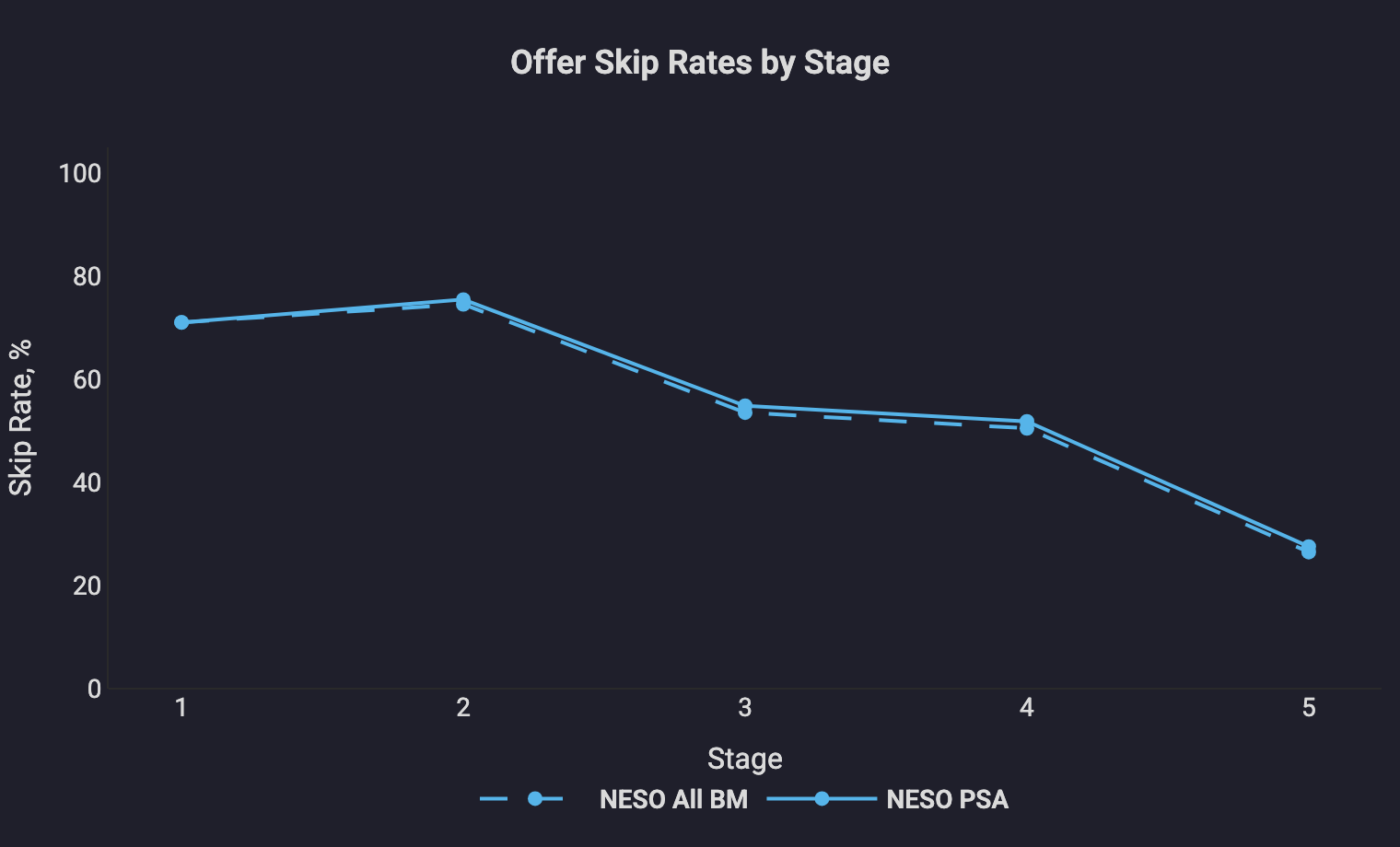
The skip rates fall most in Stages 3 (System Tagged) and 5 (Long Notice). But look at where the unit itself is excluded: almost entirely in Stage 4 (Unwinds). Direct Exclusions are clearly only part of the picture.
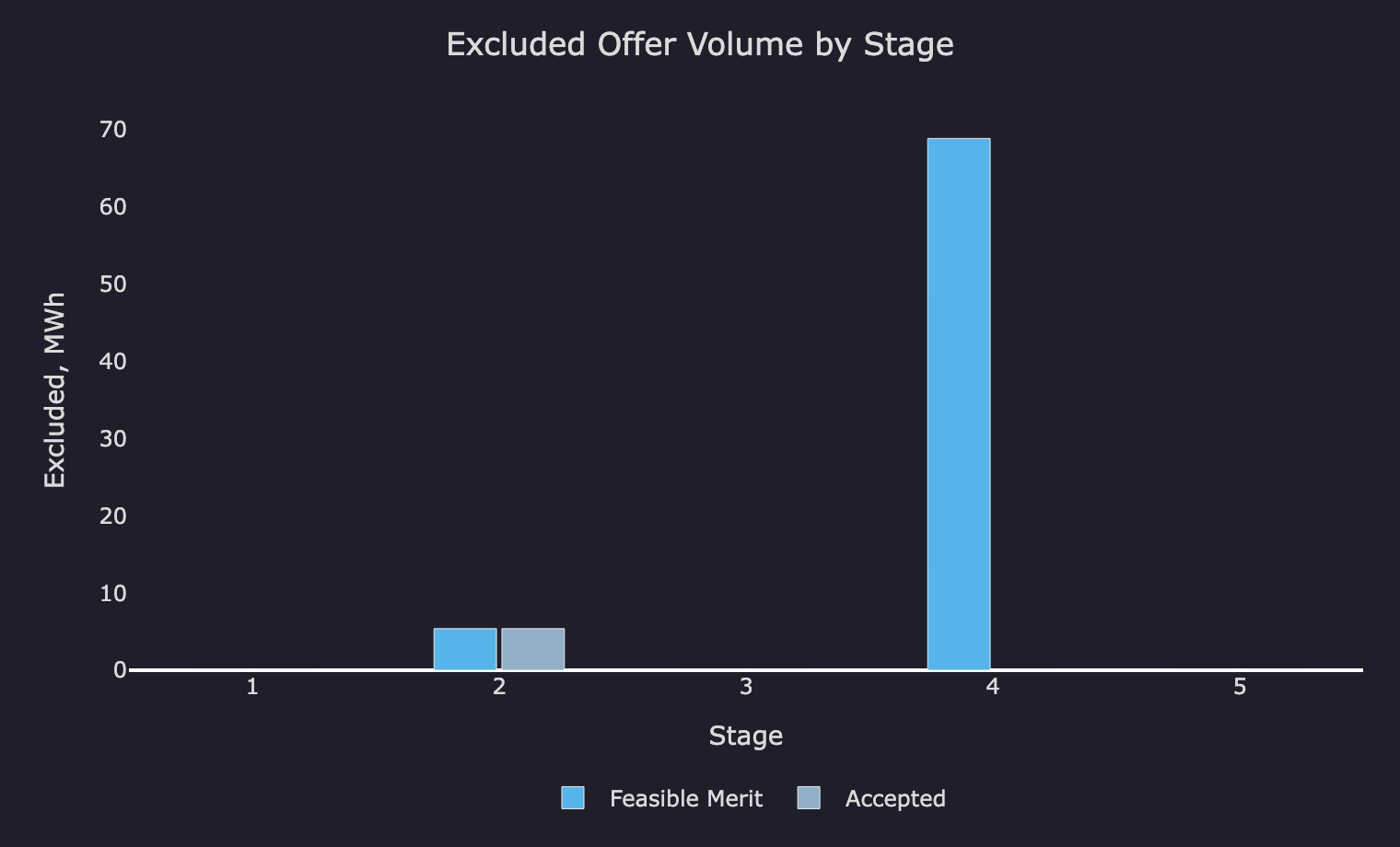
What's happening here?
To get to grips with this we need to zoom up a level, and look at how the whole system is treated in the calculations.
The falls in skip rates at Stages 3 and 5 are system-wide, not just affecting batteries. Also something counterintuitive happens in the All-BM case.
What's the difference between All BM and PSA?
In the PSA (Post System Actions) case, Stage 3 removes System Tagged acceptances from the Acceptance Stack used to evaluate the Imbalance Requirement.
As a reminder, the Imbalance Requirement is the sum of all acceptances for the period in question after exclusions for that stage. At Stage 0 that's all acceptances. Note that at Stage 3 the exclusions apply to PSA, tagged acceptances are not removed from the Imbalance Requirement for All BM.
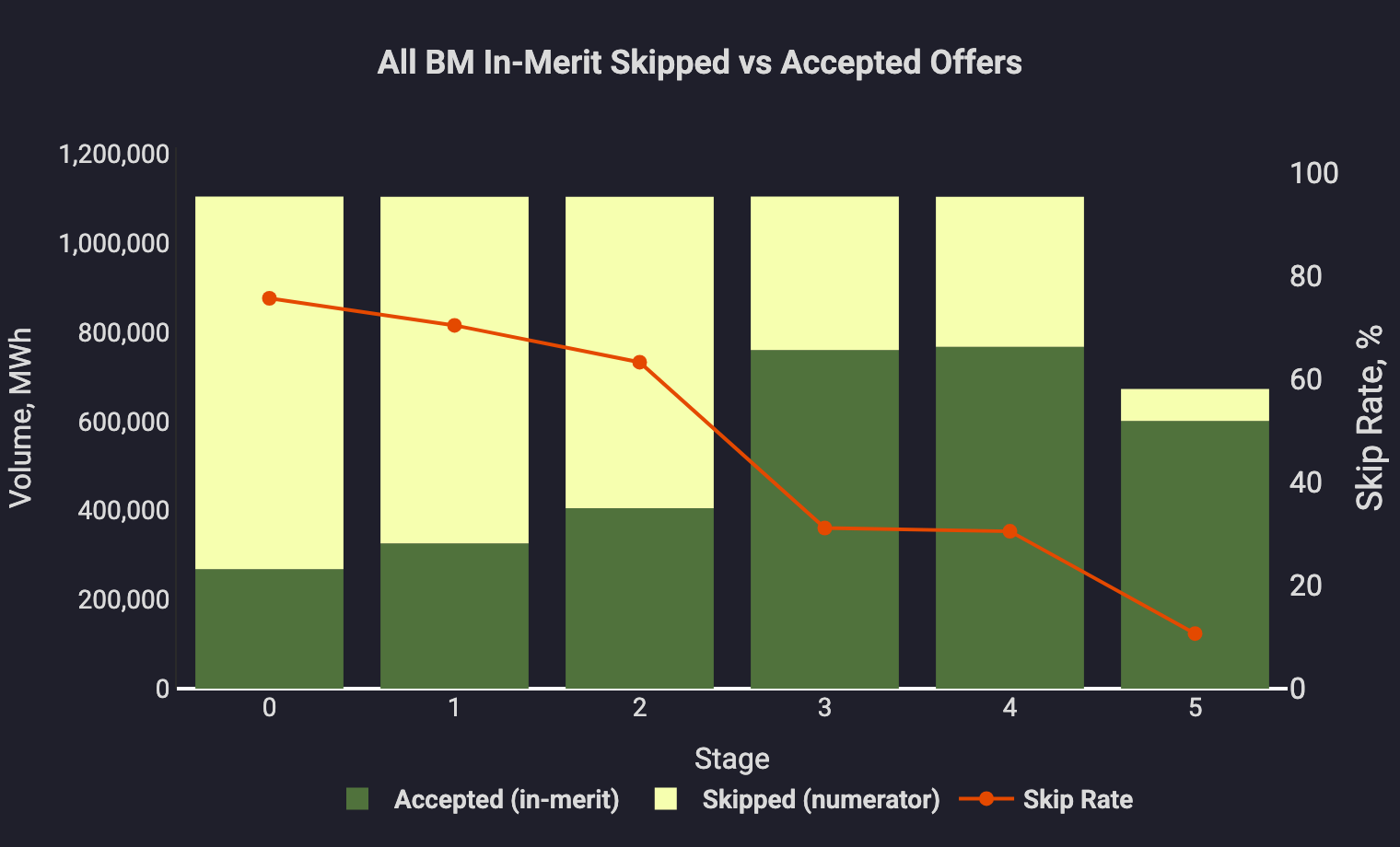
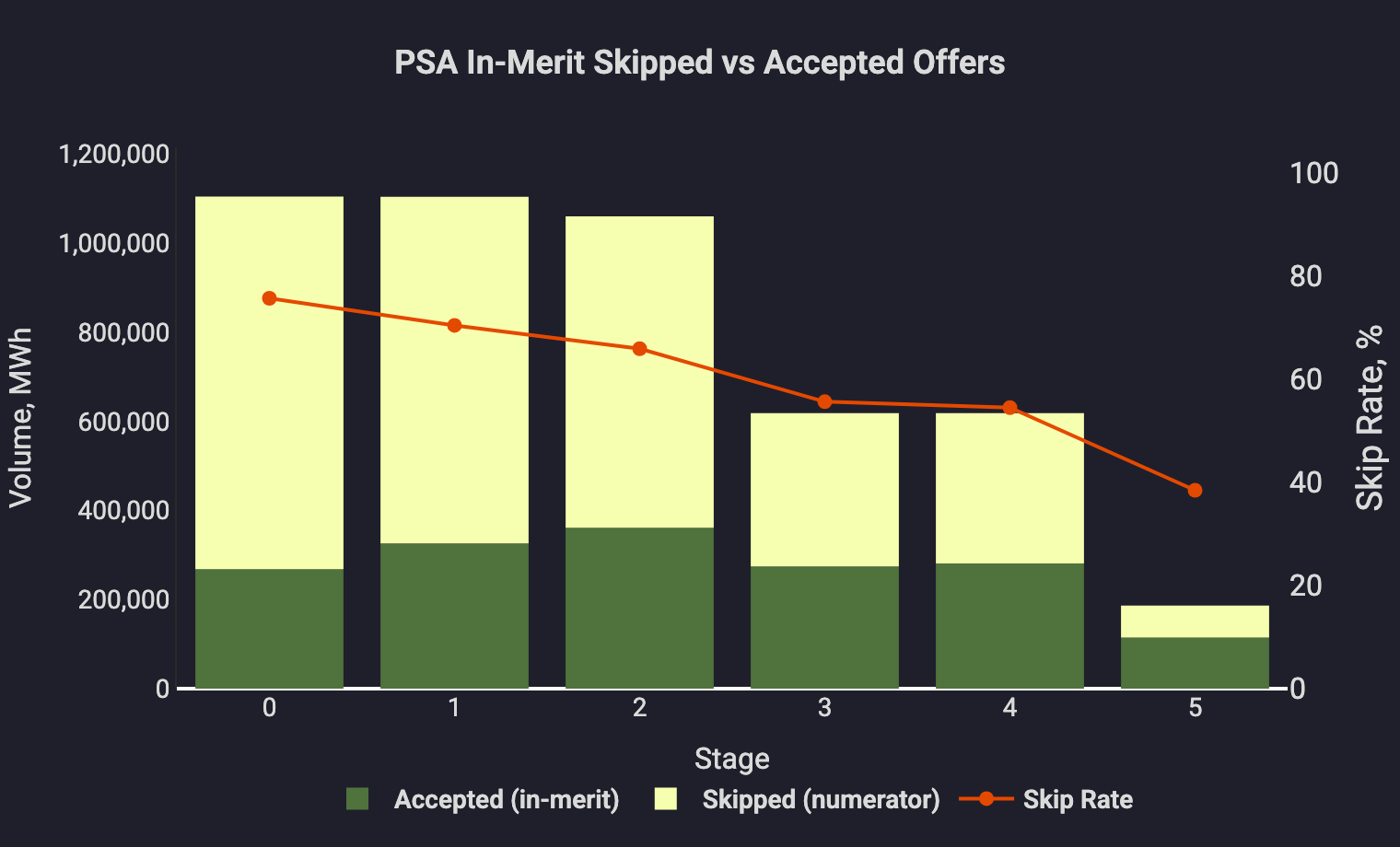
In the charts above, the height of the bars represents the Imbalance Requirement, which for PSA falls in Stage 3 when system tagged acceptances (mostly from CCGTs) are removed, and in both cases falls again in Stage 5 when acceptances from long-notice units (also mostly CCGTs) are removed.
The All BM metric is a little counterintuitive. It wants to keep those system acceptances in the calculation. But rather than being just a neutral operation which would leave the order unchanged, it forces all of the tagged acceptances into the In Merit Stack, regardless of price order, on the grounds that those tagged acceptances had to be accepted. This displaces other unaccepted units. This is why you see the green Accepted bar increase in Stage 3 of the All BM chart above.
Now that we have a mental model of what's happening, it is instructive to look at an illustration of this for a single half hour.
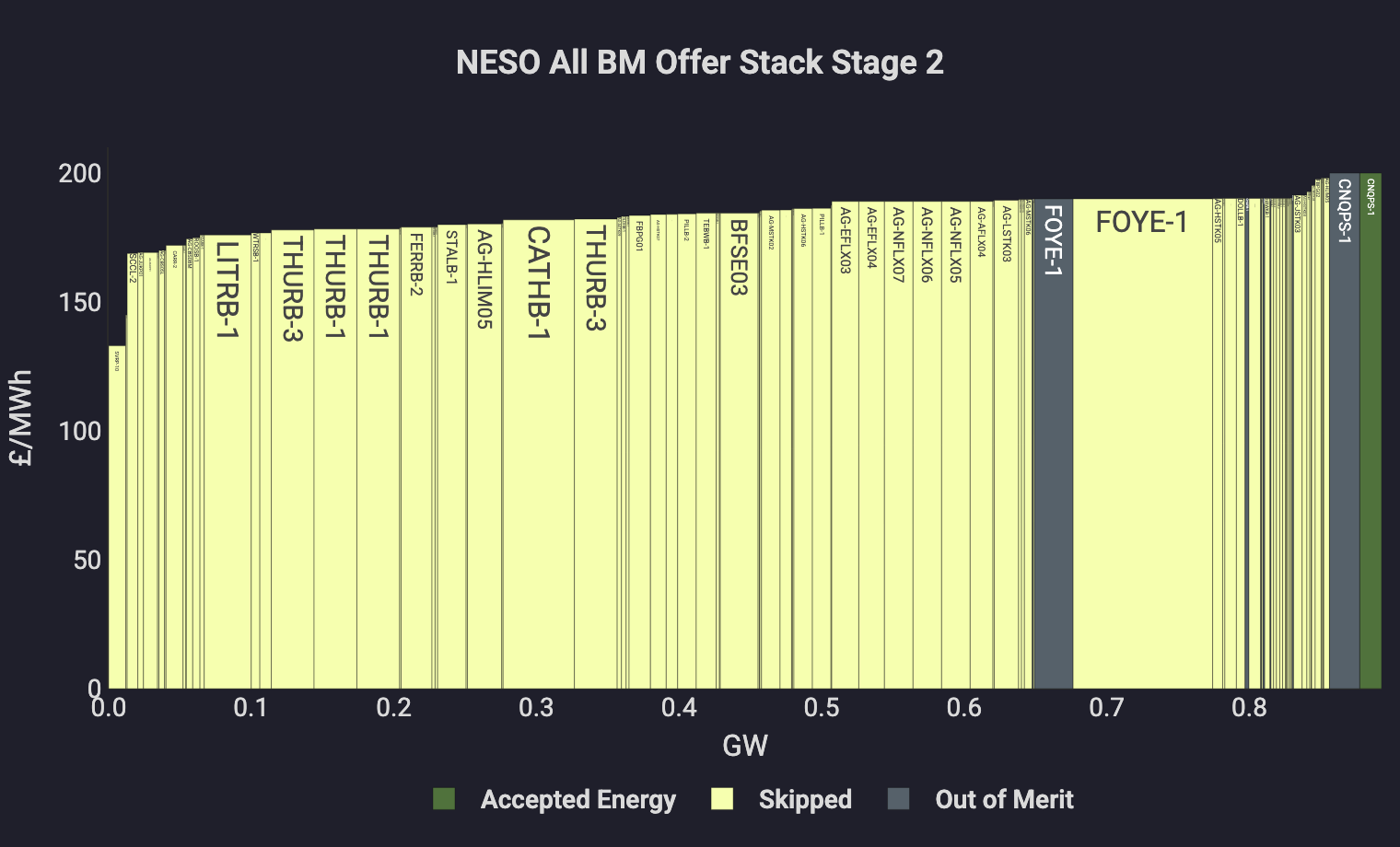
In Stage 2 there is a large set of offers which get classed as Skipped.
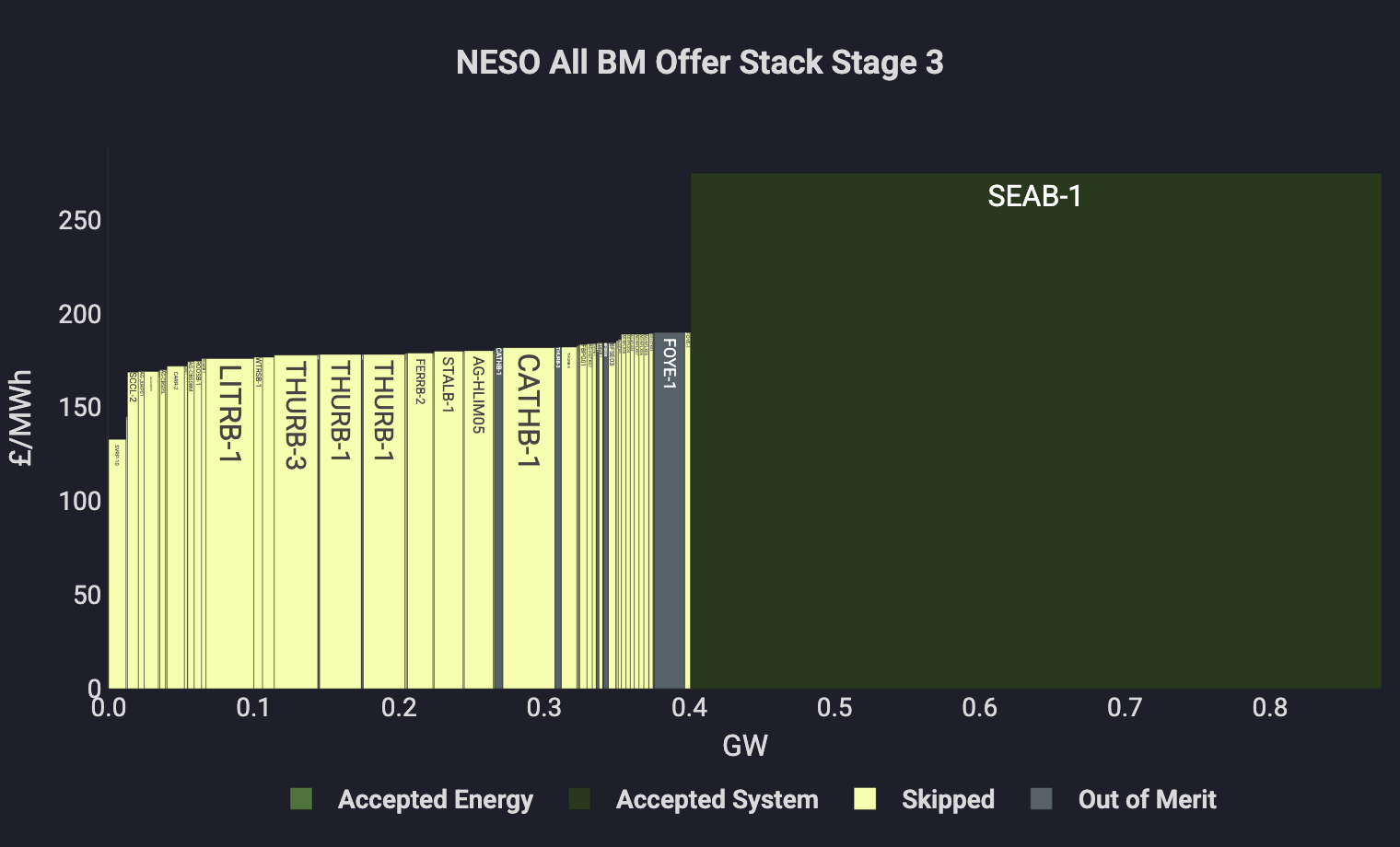
After Stage 3 'exclusions', Seabank (in this case, it could be any of many CCGTs) gets inserted into the stack, displacing many offers which were deemed Skipped at the previous stage. This is an example of Displacement.
Note that this does not happen in the PSA case, where system accepted offers just stay out of the calculations. Orders get removed, but through Indirect Exclusion.
At Stage 5, both skip rates fall in the same way. Here, acceptances from long notice orders are removed from the Acceptance Stack for both cases, reducing the Imbalance Requirement, leading to Indirect Exclusion in both methods.
So why are All BM and PSA skip rates so similar?
Despite seeing very different treatments in All BM and PSA, we saw at the start of this page that this unit's All BM and PSA skip rates were very close to each other. This is typical of batteries and not just a one-off for this example.
Why does this happen?
The skip rate is the ratio of skipped volume to all volume in the In Merit stack. The skipped volume is the same for PSA and for All BM. This leaves the metrics differing only in denominator, and the denominators differing only through which accepted orders are included in the In Merit stack.
When you filter all orders for a single unit, especially for a battery, it's unlikely that it has a lot of system tagged acceptances, so the denominator is little-changed between the two metrics.
CCGTs which have many system acceptances do show a difference. A breakdown of how the fuels differ (this was taken for August 2026) is given below.