Skip Rates
This page explains what a skip is, how NESO defines and measures skip rates.
What is a skip?
In theory, for pure energy balancing, NESO accepts bids and offers in the balancing mechanism in strict price order from least to most expensive. In reality, price is just one of the parameters which need to be considered in balancing actions.
A skip occurs when a unit which was in merit and accessible to NESO was not accepted, in favour of a more expensive unit.
Skips on batteries get the most attention, but any fuel type in the balancing mechanism can be skipped.
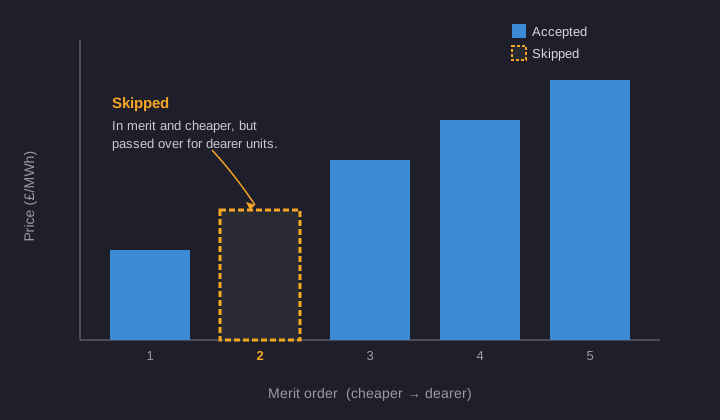
Ordered from cheapest to most expensive, unit 2 is in merit and cheaper than units 3–5 yet it is passed over while those more-expensive units are accepted. This is a skip.
How NESO calculates skip rates
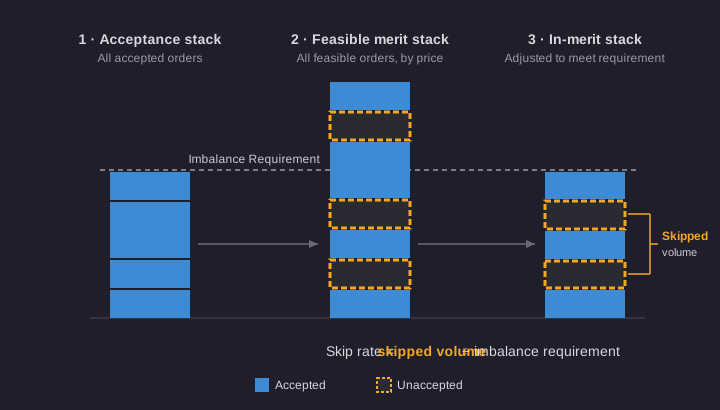
NESO produces a Volume-Adjusted In Merit Stack, to meet an Imbalance Requirement based on the accepted orders in a 5 minute period. The skip rate is the ratio of unaccepted to total volume in the Volume-Adjusted In Merit stack.
Skip rates are caclulated separately for bids and offers, referred to as 'orders' in the process outline below. The full NESO methodology is documented here.
Imbalance Requirement
NESO evaluates an Imbalance Requirement which is used to determine which orders were deemed In Merit. This is a volume & price-based merit order evaluation, and models an in-merit stack in a perfect skip-free world.
First NESO takes all accepted orders to form the Acceptance Stack. This is the set of all accepted orders for a 5 minute period.
The Imbalance Requirement is then simply the MWh sum of the the acceptance stack.
Feasible Merit Stack
To derive the Feasible Merit Stack, NESO stacks all orders which could be used to meet the Imbalance Requirement in order of cost (offers from lowest price to highest, bids from highest price to lowest). This stack is not constrained by the Imbalance Requirement.
Volume-Adjusted In-Merit Stack
The Volume-Adjusted In-Merit Stack is simply the Feasible Merit Stack required to meet the Imbalance Requirement. The volume adjustment truncates the stack to meet the Imbalance Requirement and adjusts orders where only part of the order is required to meet the requirement.
Skipped Volume & Rates
The Skipped Volume is the MWh sum of the unaccepted orders in the Volume-Adjusted In Merit Stack. The skip rate is the ratio of Skipped Volume to Imbalance Requirement.
The process above provides 'Stage 0' skip rates, which take no account of whether non-price constraints would have prevented an order from being accepted.
All BM vs PSA
NESO calculates skip rates on two different bases:
- All BM includes all acceptances in the Acceptance Stack.
- PSA (Post System Actions) removes system tagged orders from Imbalance Requirement (the denominator in the skip rate calculation).
Exclusions
NESO doesn't treat every unaccepted in-merit order as a skip. Instead it applies a successive set of exclusions to the feasible stack (the numerator in the skip rate calculation) before doing any calculations to remove orders which were theoretically but not practically available to NESO.
| Stage | What it removes |
|---|---|
| 1 | Wind offers |
| 2 | Very-long-notice units, units behind active constraints |
| 3 | System-tagged units |
| 4 | Unwinds - orders which would undo existing acceptances |
| 5 | Long-notice units, infeasible pumped storage, and units ramping between 0 and SEL |
| 6 | Mandatory Frequency Response (MFR) |
By comparing the real-world decisions made by the control room engineers with a stylised perfect world scenario, the standard skip rate metric is a good metric for its intended use: to understand how efficiently NESO managed the dispatch at a system level. The unaccepted orders which are commercially in merit but fall outside of the Volume-Adjusted In Merit Stack are still felt by asset owners but don't get classed as skips. We developed the Commercial Skip Rate to give the asset owners' perspective on this.